How much does a CRM really cost?
“How much will a CRM cost me?” This is a recurring question from our clients. Investing in a CRM is a strategic commitment, but also a financial one. However, not having a CRM can cost even more : lost opportunities, operational inefficiency, and a lack of visibility. Let’s break down the costs associated with a CRM to better understand this investment.
The main stages of CRM implementation and their associated costs:
To help you understand, here is an overview of the key stages in choosing, implementing, and managing a CRM.
1. Tool benchmarking and needs assessment:
1. Choosing the tool:
Before tackling the cost of the tool, you must first determine your needs and which tool to choose. You need to identify the CRM that is right for your industry and your business requirements. Some CRMs are specialized by industry; for example, "Toast" and "Eat App" are designed to make things easier for hotels and restaurants. Company size also influences the choice of tool, as it affects the volume of data the CRM will need to handle.
Some CRMs only support small amounts of data. For micro-businesses, solutions like Sellsy, HubSpot Free may be suitable, while SMEs and mid-market companies will turn to more robust solutions like Pipedrive or mid-market offerings from Salesforce and HubSpot, which combine flexibility with extensive features. Large enterprises, on the other hand, prefer comprehensive and customizable platforms such as the premium editions of Salesforce (Core, Advanced, or Max as of September 2026) or Microsoft Dynamics 365, which are capable of handling massive data volumes and complex processes often associated with a multitude of sales pipelines, teams, multi-product lines, etc.
If your processes are complex and your automation needs are extensive, ensure the tool can handle them. Keep in mind that the two most widely used CRMs on the market are HubSpot and Salesforce.

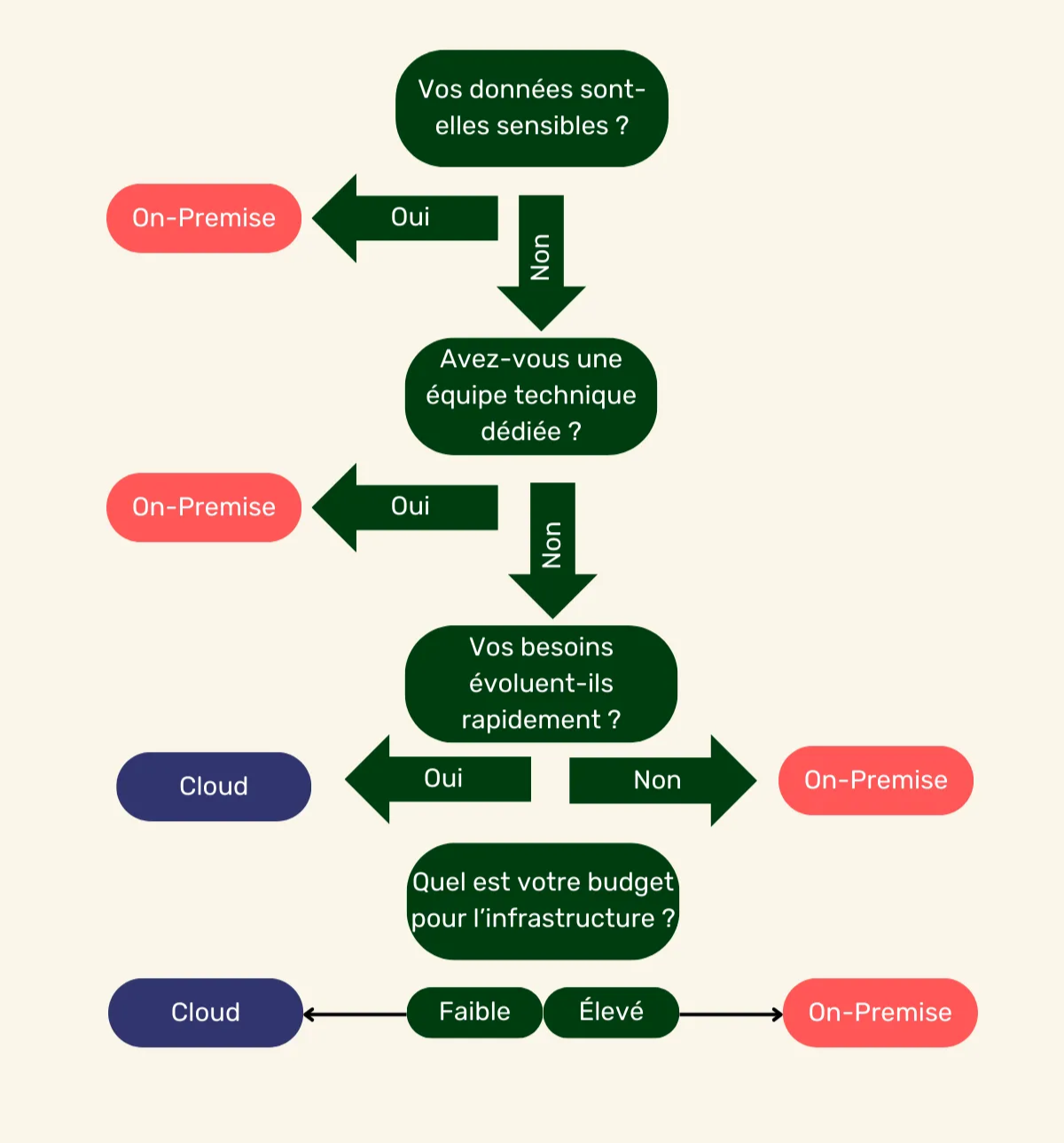
Today, the majority of companies opt for the cloud to host their data, a modern and flexible solution that has largely replaced the on-premise systems of the 2000s. This eliminates the need for costly initial infrastructure investments, as all data is stored and managed directly by the provider. Costs related to storage, maintenance, and updates are included in the subscription, which previously made expenses very predictable. This is no longer entirely true: with the arrival of AI agents billed by usage (see pricing criteria below), a portion of the bill has become variable. It also allows for easy addition of users or features as the company grows, while providing your teams with access to data from anywhere to foster collaboration, especially remotely. However, this solution requires careful attention to data governance.
If you are still wondering, we have built a decision tree to help you see things more clearly:
2. Pricing Criteria:
There are different types of CRMs, including those focused on sales or marketing. Although they can be integrated into the same platform, the features differ significantly depending on the needs:
•A sales CRM focuses on managing pipelines, opportunities, and sales processes.
•A marketing CRM offers tools to manage campaigns, automation, and contact segmentation.
- For a sales CRM, the cost is generally based on the number of licenses required, meaning the number of users who will access the platform. Each active user contributes directly to the overall cost.
- For a marketing CRM, the pricing criteria are more complex. In addition to the number of users, other factors influence the price:
The subscription plan: The included features vary depending on the chosen subscription (advanced automation, analytics, segmentation, etc.).
The volume of contacts: Pricing is often defined by tiers based on the number of marketing contacts in your database. The more contacts you have, the higher the cost.
- Since 2026, a third criterion has become essential: AI consumption. Major vendors now charge for seats and the use of AI agents, via credits.
Our conviction: the included credits may seem generous, but they are model-dependent. Estimate your volume of actions, set caps, and track consumption every month, otherwise this line item will become an unpleasant surprise on your invoice.
2- CRM implementation
1. Implementation
A CRM is like a high-end car. Even with the best models on the market, the vehicle won't start on its own. These tools offer intuitive interfaces and ready-to-use features to meet the most common needs, but simply turning the key isn't enough to get moving. Without careful thought regarding data structure and proper configuration, you risk utilizing only a small fraction of its potential. This is why its integration goes beyond mere technology; it is an organizational transformation, which requires guidance to ensure results that meet your expectations.
For example, here is the timeline for a Salesforce implementation:
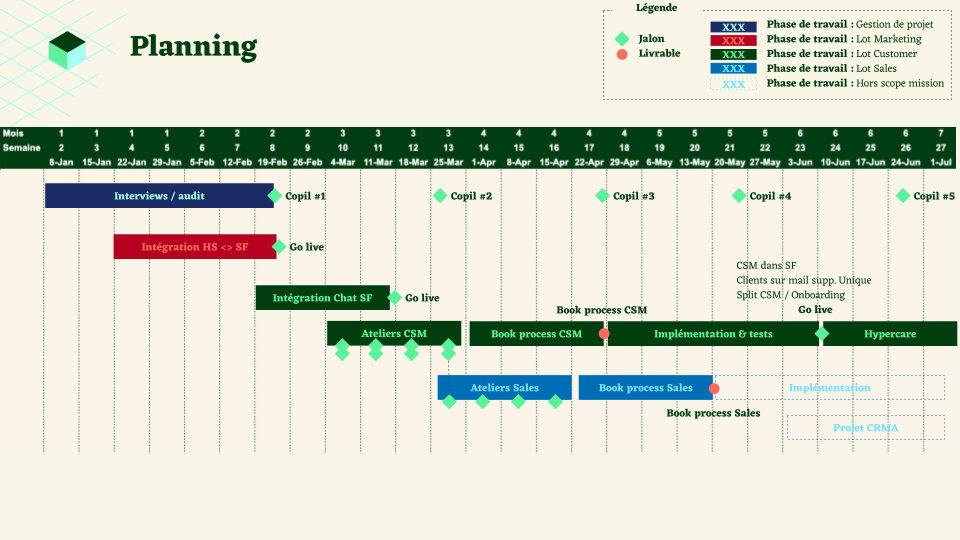
For Salesforce, implementation costs on average between €15,000 and €50,000 for SMEs, and €50,000 to €150,000 or more for large enterprises, with an average project duration of 12 to 18 weeks.
For HubSpot,the simplest integrations start between €5,000 and €15,000, often faster thanks to its intuitive interface. You should expect between 3 to 8 weeks for a successful implementation. For more complex integrations, the price can increase significantly as it requires more resources to execute the project.
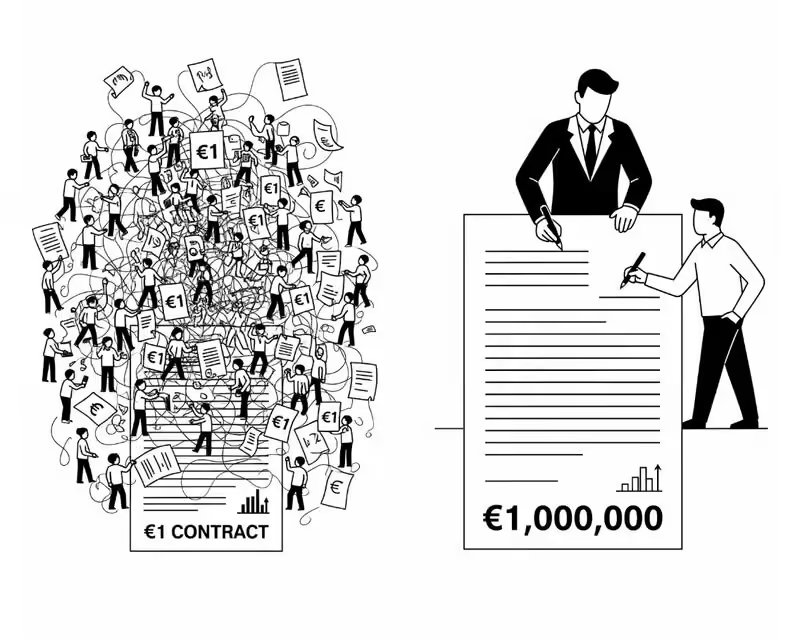
Internally, CRM integration can quickly become complicated: a mountain of data to migrate, teams to reorganize, and habits to change. It can easily descend into chaos. Changing processes, especially for sales, marketing, or support teams, can naturally trigger resistance. Without a clear method or perspective on the tool, it is easy to miss out on best practices or build a fragile data architecture. The result? A poorly used tool, frustrated teams, and a precious waste of time and money.
You need to ask yourself : What are the right settings to configure the tool Should you automate certain repetitive tasks to save time? How do you connect your CRM to other company systems, such as your marketing tools, customer databases, or ERP? And now: are your data ready for AI agents, and who governs what these agents are allowed to read, write, and consume?
There are many questions to ask during implementation, and each answer must be carefully considered so that your CRM supports the alignment between business realities and your objectives.
2. Migration
The context of changing tools must also be taken into account: company restructuring after an acquisition, necessary automation to optimize costs, modernization of tools, or changes in management. This can lead to operational costs such as a temporary slowdown in activity, user training, and managing resistance to change, which can extend adoption timelines.
Our field expertise allows us to anticipate these challenges and create truly tailored solutions, taking user needs into account to ensure a successful CRM implementation.
3-Maintenance and evolution:
You will need to dedicate someone internally to regularly perform data cleaning, technical maintenance, and process optimization to maximize team performance.
A CRM represents not only an initial cost but also a long-term commitment. Among the future expenses to anticipate, maintenance and support play a central role. These services ensure the platform runs smoothly on a daily basis, provide rapid resolution of any technical issues, and keep the system regularly updated to remain compliant with technological and regulatory changes.
Theevolution of the platform is also a key factor. As your business grows and your needs change, you may need to add new features, integrate other tools, or adapt your processes. These adjustments, while beneficial for your performance, will inevitably lead to additional costs that should be anticipated.
In 2026, some costs are also less visible in the initial quote: AI modules added to licenses, credit consumption beyond the included allowance, or evendata enrichment, which is now often billed in credits. Conversely, some new editions include elements that were previously paid for separately, such as premium support for Salesforce: always compare offers with an equivalent scope.
Investing in the maintenance and evolution of your CRM ensures it remains a performance driver for your teams, aligned with your long-term goals. A neglected or obsolete CRM risks causing inefficiencies that will cost the company much more in the long run.
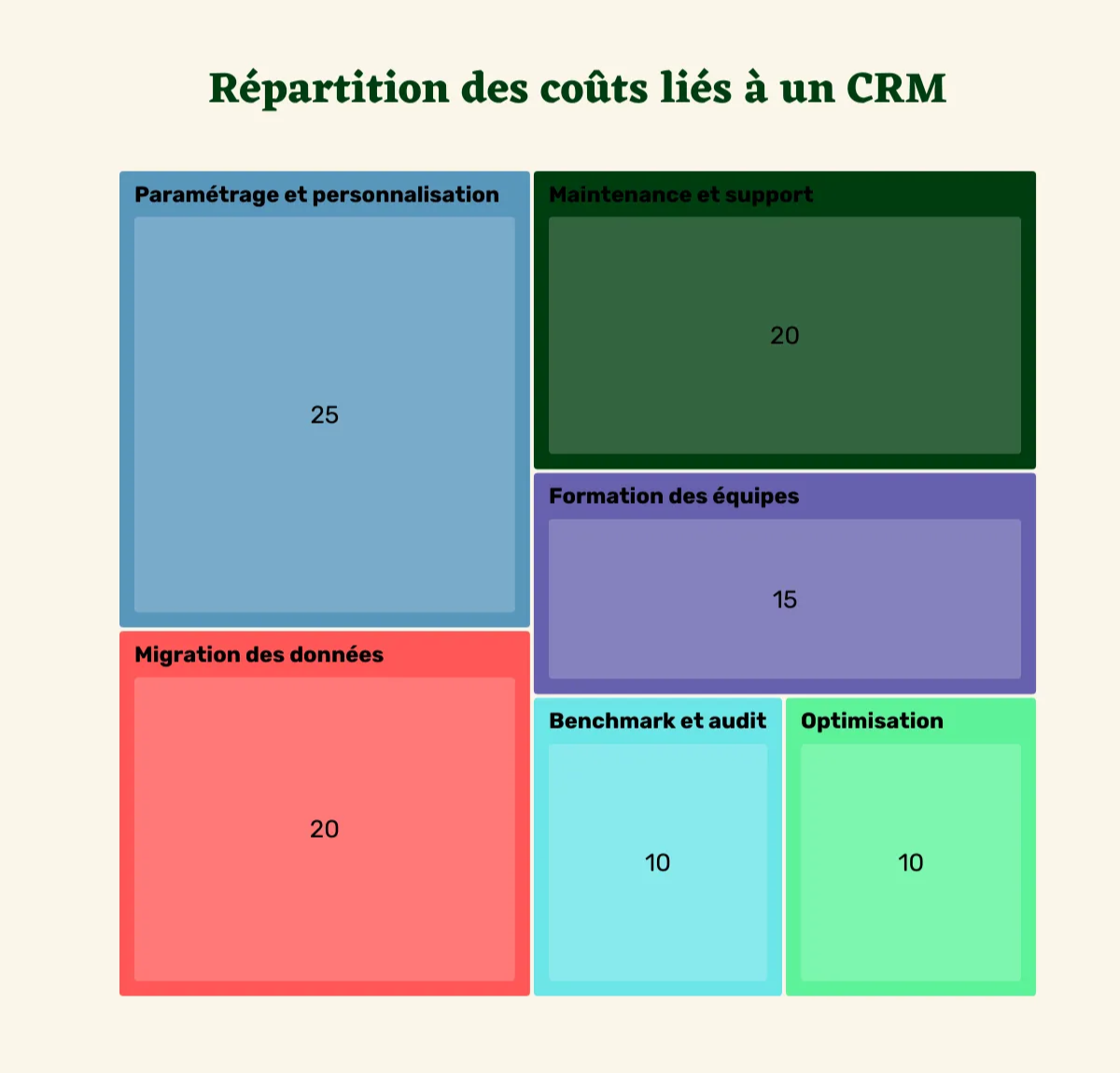
3. Summary of CRM costs

Conclusion
Implementing a CRM is not just buying a tool; it is a program : scoping needs and benchmarking, making an informed pricing choice, structured implementation & migration , and then maintenance and evolution continues. Value comes less from features than from thealignment with processes, from the data quality and from clear governance . To manage the total cost of ownership (TCO), clearly distinguish between initial costs (licenses, integrations, implementation) and recurring costs (support, data quality, scaling, AI consumption), and track KPIs focused on adoption and performance (usage rates, pipeline velocity, % of fields completed, duplicates per 1,000 records). With AI, this point becomes decisive: according to Gartner, AI already saves a salesperson nearly five hours per week, yet 72% of organizations do not reinvest this time into high-value activities. The highest cost is therefore not the license, but a tool that is poorly adopted or not used at all.
In practice, remember:
- Start with use cases and volume, not the brand.
- Plan change management on the same level as the technical side.
- Industrialize data quality (prevention + remediation).
- Budget AI by usage : model consumption and set caps before deploying agents.
- Establish a 12–18 month roadmap with quarterly reviews.
This way, the CRM becomes a sustainable operational asset, capable of evolving with the company while keeping costs under control.

Quelques chiffres